
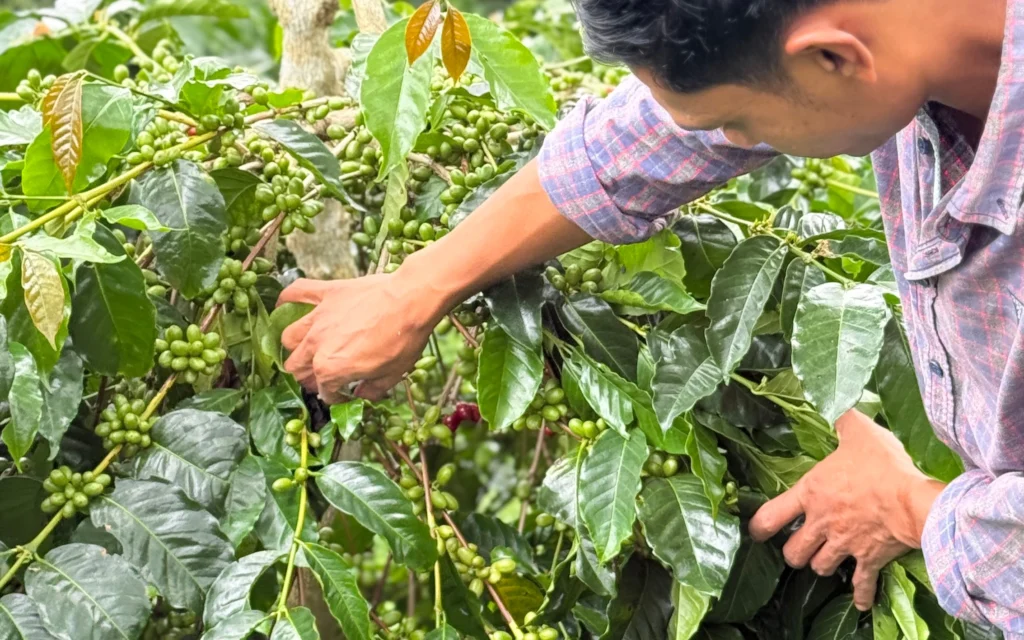
The Gayo coffee farming process begins long before beans enter the export chain, in highland farms where smallholder decisions quietly shape quality, yield, and long-term supply stability. In the Gayo Highlands of Aceh, coffee farming is not driven by industrial scale, but by generational knowledge, environmental adaptation, and careful timing.
For importers seeking origin transparency and predictable quality from Indonesia, understanding how Gayo Arabica is planted, cared for, and harvested provides essential context for the coffee’s consistency and resilience within a smallholder-based supply system.
Gayo Coffee Farming Process
1. Planting Gayo Coffee
Planting Gayo coffee begins with careful seed selection. Farmers typically raise seedlings in shaded nurseries for several months before transplanting them to the field. Gayo cultivation relies on shelterwoods—shade trees such as lamtorogung, orange, and avocado—to provide partial shade and organic material for fertilization.
Planting sites are chosen based on altitude, slope, and soil structure.
Most farms are located between 900 and 1,700 meters above sea level. Administratively, the Gayo Highlands cover the districts of Aceh Tengah, Bener Meriah and Gayo Lues where the three main towns are respectively Takengon, Simpang Tige Redelong and Blangkejeren.
Coffee trees are spaced to allow adequate airflow and sunlight while still benefiting from shade trees. This shade-grown system is a defining feature of Gayo coffee cultivation, helping regulate temperature and protect young plants from extreme weather.
2. Plant Care and Maintenance
Once established, coffee plants require consistent care year-round. In the Gayo Highlands, maintenance focuses on pruning, weed control, soil management, and pest prevention.
Pruning is carried out regularly to maintain plant structure, improve airflow, and encourage productive branching. This practice helps stabilize yields and supports uniform cherry development.
Fertilization practices vary by farm, but many farmers rely on organic or semi-organic inputs, including compost made from coffee pulp and other agricultural waste. The fertilization takes place twice a year using coffee beans’ shells and manure from cows as fertilizers.
Weed control is typically done manually, reflecting both the terrain and the labor-intensive nature of smallholder farming. Pest and disease management—particularly the prevention of common issues like leaf rust—is handled through early detection and clean-farm practices rather than heavy chemical use.
Shade regulation, proper pruning, and farm cleanliness are key strategies. These practices directly contribute to Gayo coffee’s characteristics, including its clean cup profile and consistent quality across harvests.
3. Farming Standards and Quality Control
Quality control in Gayo coffee farming begins at the farm level, long before post-harvest processing. Farmers are trained to recognize optimal ripeness, maintain clean harvesting tools, and separate defective cherries early.
In many producing areas, cooperatives and local institutions provide guidance on good agricultural practices (GAP), traceability, and sustainability standards.
Documentation and lot separation are increasingly common, especially for export-oriented supply chains. This allows buyers to trace coffee back to specific villages or farmer groups, supporting transparency and quality assurance.
While certification schemes vary, the emphasis on consistency and accountability has become a core part of Gayo coffee quality control, particularly for buyers seeking reliable long-term partnerships rather than spot purchases.
4. Harvesting Practices
Gayo coffee harvest typically takes place once a year, with the peak season varying slightly by altitude and microclimate. Harvesting is done manually through selective picking, where only fully ripe coffee cherries are collected.
Selective harvesting may require multiple passes through the same plot, as cherries ripen at different times. Farmers understand that harvesting too early or too late can compromise cup quality, which is why timing is treated as a critical skill rather than a fixed schedule.
After harvest, cherries are quickly transported for processing to minimize quality degradation. For global buyers, these harvesting practices signal a supply chain that prioritizes quality over volume. While yields may fluctuate due to climate or labor availability, the commitment to careful harvesting reinforces the long-term value of Gayo as a specialty origin.
Environmental Factors in the Gayo Highlands
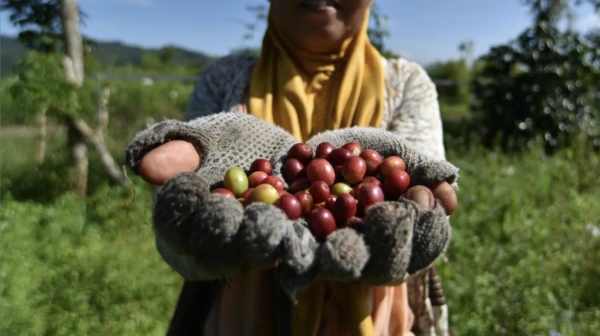
Environmental conditions in the Gayo Highlands directly shape the reliability and outcomes of the Gayo coffee farming process. Located at elevations of approximately 900–1,700 meters above sea level, the region offers cool temperatures, consistent rainfall, and fertile volcanic soil that support slow, even cherry development.
Volcanic soils in Central Aceh and Bener Meriah provide strong drainage and mineral availability, reducing the risk of root disease while supporting healthy plant growth. Combined with shade-grown systems, these conditions help buffer coffee plants against temperature fluctuations and seasonal stress, which is increasingly relevant under shifting climate patterns.
From a supply perspective, environmental constraints also influence operational realities. Steep terrain limits mechanization, reinforcing manual harvesting and selective picking. Rainfall variability can affect flowering cycles and harvest windows, contributing to lot differentiation rather than uniform volume output.
For buyers, this means that quality consistency is closely tied to how well farming practices are adapted to local environmental conditions. Understanding these environmental factors allows buyers to better assess production risk, seasonal variation, and long-term sourcing potential when working with Gayo as a specialty coffee origin.
Why the Farming Process Matters to Coffee Buyers?
For global importers and buyers, understanding the Gayo coffee farming process provides insight into more than just agricultural technique. It reveals how quality, sustainability, and supply reliability are managed at origin.
Smallholder-based farming systems require strong coordination, but they also offer advantages. Hands-on plant care, selective harvesting, and quality control led by the cooperative contribute to consistency despite fragmented production. Buyers who understand these dynamics are better equipped to assess sourcing risks and build long-term partnerships.
Companies that engage closely with origin partners, such as Shahin Agri, often focus on aligning farming practices with buyer expectations. This includes supporting quality standards, improving traceability, and ensuring that farming processes remain resilient amid climate and market pressures.
Final Thoughts
The journey of Gayo Arabica coffee begins long before it reaches export warehouses or roastery floors. It begins with planting Gayo coffee in highland soils, continues with disciplined plant care and quality control at the farm level, and culminates in selective harvesting practices adapted to local environmental conditions.
Understanding the Gayo coffee farming process enables buyers to see Gayo not just as a geographic origin but as an interconnected system. Smallholder farming, cooperative coordination, and environmental adaptation work together to influence quality consistency, supply reliability, and long-term sustainability.
For global importers and buyers, this context matters. It provides a clearer basis for assessing production risk, seasonal variation, and partnership potential. In an industry increasingly defined by transparency and resilience, Gayo Arabica coffee stands as an origin where farming practices, environmental realities, and market expectations are closely aligned.